What Psychology Really Tells Us About the Way We Invest
Sep 3, 2026
Most investors like to believe they make decisions with a calculator, not a nervous system. They read the factsheet, compare the CAGR, check the expense ratio, and assume the rest is simple arithmetic. Then the market falls twelve percent in a fortnight, and somehow all that arithmetic goes out the window in about four seconds.
Behavioural economics has spent decades studying exactly this gap — the distance between the investor we think we are on a calm Tuesday and the investor we actually become the moment real money is on the line. And once you start paying attention to it, a lot of your own past decisions start making a lot more sense, including a few you'd probably rather forget.
The Ancient Wiring Behind Modern Panic
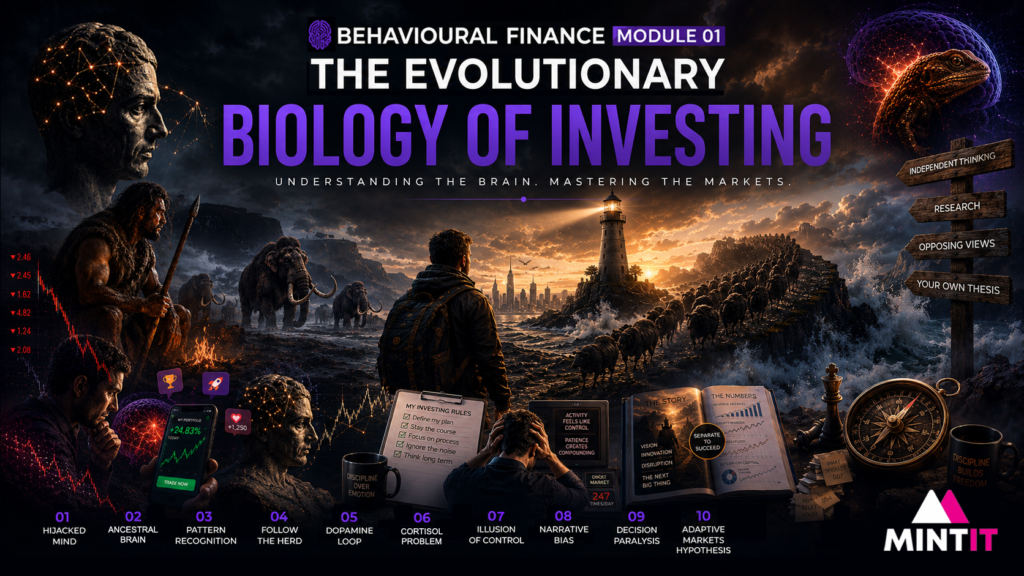
Take the moment your portfolio turns red. There's a small, almond-shaped part of the brain — the amygdala — whose entire job is to detect danger and get you moving before conscious thought even arrives. It served our ancestors extremely well for a few hundred thousand years, and it still can't tell the difference between a predator in the bushes and a falling Nifty. That frozen, panicky feeling during a crash isn't a lapse in discipline. It's biology, doing precisely what it was built to do, several thousand years too late for the job it's now been handed.
This wiring didn't arrive by accident, either. Somewhere far back, the people who reacted fastest to danger tended to survive it, and the calm, deliberate ones didn't always get the chance to pass on their genes. Which means the instinct to buy when everything feels abundant and sell when everything feels scarce — more or less the opposite of sound investing — isn't a character flaw picked up along the way. It's inherited. Telling yourself to "just be more disciplined" tends not to work very well, because discipline was never really the problem.
There's also a pattern-hunting streak in the human brain that fires whether or not an actual pattern exists. Four bounces off the same support level and most investors will swear they've found a rule of the market, quietly skipping the step where they check whether the conditions behind those four bounces are still around. The same instinct that once taught someone's ancestor to recognise a dangerous trail now convinces a modern investor that coincidence is a law of physics.
Then there's the crowd. For most of human history, drifting away from the group carried real risk, so sticking close to what everyone else was doing became a genuinely sound strategy. That wiring hasn't gone anywhere. A stock feels safer purely because three people in a family WhatsApp group are buying it, and dangerous the moment they start selling, regardless of what the underlying business is actually doing.
Chemistry, Control, and a Good Story
Two chemicals do a fair amount of the remaining damage. A winning trade releases a hit of dopamine that quietly convinces the brain luck was skill, nudging the next bet a little bigger and a little riskier. A losing one floods the system with cortisol, narrowing attention and pushing toward exactly the kind of short-term, reactive decision a long-term investor is trying to avoid. Neither chemical has read the investment plan sitting in a drawer somewhere, and neither seems particularly interested in it.
Somewhere in among all this sits a very human appetite for feeling in control. Checking a portfolio seventeen times a day, switching funds after one bad quarter, moving in and out of gold on the strength of a headline — none of it functions as strategy so much as anxiety wearing strategy's clothes. Most of what actually moves markets, from interest rate decisions abroad to a weak monsoon at home, sits well outside any individual investor's reach. What remains within reach is far less dramatic: how the money is allocated, how much of it gets saved every month, what it costs to hold, and how rarely anyone interferes with the compounding that's already underway.
Add to this the pull of a good story. A founder who mortgaged his house to keep a company alive will always land harder than a fourteen-page report on rolling returns, even though the report is doing the more honest work. Brains remember narrative far better than they remember numbers, which is exactly why "ride the Digital India wave" sells more units than "these specific companies, at these specific valuations" — even though only the second sentence is actually protecting anyone's money.
None of this even accounts for the sheer volume of information most investors try to process before making a single decision. Seventeen news alerts, four Telegram tipsters, a market-outlook video and a call from the family CA all competing for attention tends to produce not a sharper decision but no decision at all, or a lazy one made simply to escape the noise. The brain doesn't get better at deciding with more input. Past a certain point, it just slows down.
And underneath all of this sits a market that keeps changing shape. Strategies that worked beautifully in a rising market can fail badly in a falling one, and investors who only remember the last crash tend to keep preparing for a war that already ended. Markets aren't perfectly rational, and they aren't purely chaotic either — they adapt, continuously, to whoever happens to be trading in them at the time.
What This Means for How You Invest
Put these ten threads together, and a fairly clear pattern shows up: skilled investing depends far less on gathering more information and far more on understanding the particular ways your own mind tends to misfire. Some readers will recognise themselves most in the panic of a crash. Others will recognise the overconfidence after a lucky trade, or the story that talked them into a purchase they never actually researched. That kind of self-recognition rarely comes from another "top funds to watch" list. It tends to come from a genuine look at the machine making the decisions in the first place .
Good financial planning, at its core, is built around this same recognition. The goal was never to remove emotion from investing — that isn't realistic, and it probably isn't even desirable. The real goal is to put enough distance between the emotional trigger and the financial decision that a calmer version of the investor gets a say too. A written plan drafted on a good day, an SIP running quietly in the background, a rule set in advance so a bad day doesn't have to think from scratch - these aren't tricks. They're just sensible responses to how the investing brain actually behaves under pressure.
At MINTIT, this thinking shapes a fair amount of how we approach investing - nudging the investors toward the quieter, automated version of investing, precisely because the exciting, reactive version tends to be where wealth quietly disappears. Markets don't particularly reward speed or conviction. They reward the investor who took the time to understand their own wiring well enough to stop working against it.
Next time a decision feels urgent, it might be worth a pause before acting on it — long enough to ask whether the urgency belongs to the situation, or to fifty thousand years of instinct that never got the memo about mutual funds.
Stop Thinking. Start Understanding.
Invest Smarter: Choose the Right Fund for You!
Schedule A CallRelated Blogs
- How to Create Wealth With Market Volatility
- Why Planning a Vacation Feels Like Scamming Your Investments?
- The Psychology Behind Portfolio Rebalancing
- SIP Growth Over Years: A Magical Chart
- Your Wealth, Your Recipe, Your Flavours and MINTIT’s Guidance
- From Mantras to Mutual Funds: The Modern Interpretation of Laxmi’s Teachings
- Insurance & SIPs Through Mutual Funds App: Perfect Duo For A Secure Future
- Women & Wealth: SIPs Empowering the New Generation of Investors
- How Long-Term SIP Investment Protects Your Future from Inflation
- Your Shield Against Inflation: Long Term SIP Investment Through MINTIT’s Mutual Fund Mobile App
- The Hidden Risk of Over-Diversifying Mutual Funds
- Hard Truths of Dividend Income
- Enjoying Regular Income Via SWP
- Farewell Warren Buffett; Lessons From Investor With Networth of Rs 14 Lakh Crore
- Why Taking Time Before Making Investment Decisions Can Be Beneficial?
- Why Risk Profiling is Important & How to Conduct Your Own?
- How to Become a Smart Investor?
- Best Attitude practices for an Investor to avoid investment biases.