Ten Ways Your Mind Misreads Money
Oct 2, 2026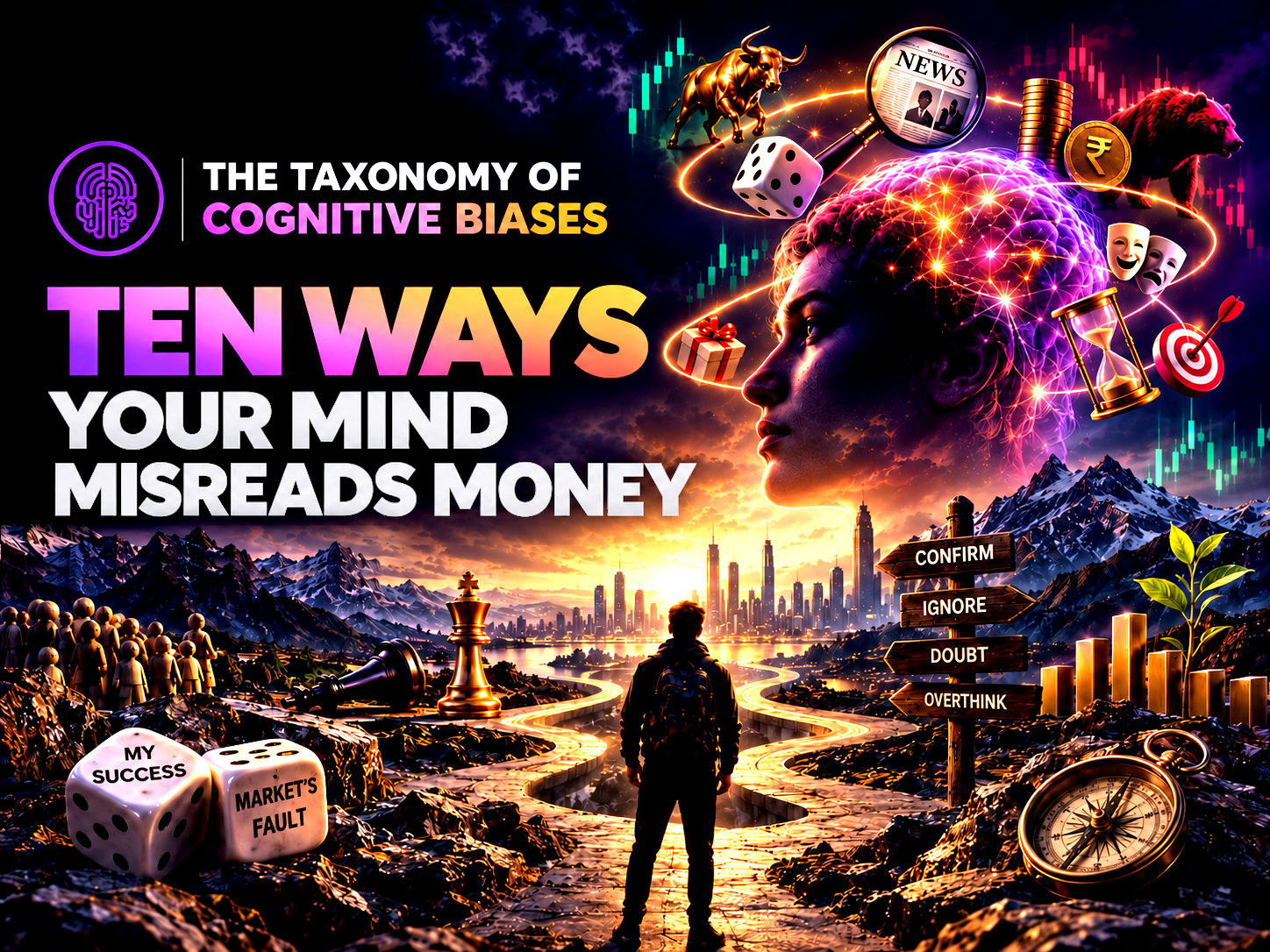
Most investors carry a flattering picture of themselves. Someone who reads the numbers, weighs the evidence and acts when the case is clear. The picture holds up well on a calm Sunday afternoon. It tends to wobble when a stock you own drops 20%. Or when a friend casually mentions a fund that doubled. Or when a bank message about your fixed deposit sits unread for a fortnight. In those moments, the person making the decision is rarely the careful analyst we imagine. And the gap between the two is where money goes missing. Behavioral economists call the habits behind it as cognitive biases.
Behavioral economists have spent decades cataloguing the shortcuts that produce this gap. They are not signs of poor intelligence. They are habits of you brain. A brain built to decide quickly with limited information, but now asked to handle compounding, volatility and 2000 fund schemes. What follows is a walk through ten of them, in roughly the order an investment decision unfolds. First how we form a view, then how we behave once we own something, and finally how we plan.
Where the Picture in Your Head Comes From
Before you buy anything, your mind has already assembled an impression of how markets behave. That impression is built from whatever is easiest to recall. Someone who lived through the 2008 crash can still see the red portfolio statement years later. That single image can outweigh a decade of recovery data when a relative asks whether to invest. This is the Availability Heuristic, and its cost is rarely a dramatic loss. It is the slow, silent price of staying out of equity long after the danger has passed.
The mirror image appears when a category has had a spectacular year. When a neighbor mentions his thematic fund returned over half last year, the story sounds sensible. Suddenly it looks like what a good investment is supposed to look like. That is Representativeness Bias. It's the habit of reading recent results as a template for the future. It rarely asks which conditions produced them and whether those conditions are still around.
Once a number has lodged itself in your head, it starts to steer. The price you paid for a stock, the high you saw last year, the first valuation a broker quoted for your flat: each becomes a ruler against which everything else is measured, whether or not the market has any idea it exists. Anchoring Bias explains why people wait years for a share to "get back to my price" instead of asking what the business is worth today.
After that, research becomes a curious exercise. Having decided you like a stock, you find twelve supportive sources and feel thoroughly informed, which is how Confirmation Bias works from the inside. It feels like diligence, and it is only half of the job. The bear case, the short-seller report and the cautious analyst note are all part of the research, and they are precisely the parts the mind prefers to skip.
Life After the Purchase
Once a position is open, the mind turns to editing. After Paytm's listing disappointed so many people, plenty of investors recalled having doubts all along, doubts that in truth were vague and fleeting at the time. Hindsight Bias smooths the past so that outcomes seem to have been predictable, which flatters us today and leaves us overconfident about tomorrow.
A close relative handles the credit and the blame. When the market rises, the gains were skill; when it falls, the culprit was foreign institutional investors, the Fed or some unforeseeable event. This accounting runs in one direction only, and Self-Attribution Bias is why a bull market can leave a new investor convinced of talent that the data never actually established. It also helps explain why so many traders carry on after sustained losses, each sure that the next attempt will be different.
Ownership adds its own distortion. Ask someone to sell what they hold and they will name a higher price than they would pay to buy the identical thing, a pattern researchers call the Endowment Effect. It shows up in the stock held through years of under-performance, and just as visibly in the flat whose asking price still reflects a market that has since moved on.
Then comes inertia, probably the least dramatic of the group and one of the most expensive. A fixed deposit renews itself, an allocation drifts as one asset runs ahead of the rest, and a policy bought two decades ago carries on because reviewing it would take effort. Status Quo Bias treats doing nothing as the safe option, forgetting that doing nothing is also a decision, and one that is rarely reviewed.
Planning With Your Eyes Open
The last two biases matter most at the point where plans are made. Optimism leads nearly everyone to believe they will land on the favourable side of a distribution that cannot possibly hold everyone. SEBI's studies found that well over nine in ten individual traders in equity derivatives lost money, yet each person who enters believes their approach is the exception. Optimism Bias inflates return expectations and shrinks the perceived risk, which is why position sizes and savings targets quietly drift out of line with what markets have historically delivered.
Choice, ironically, can freeze the very people who want to begin. Faced with more than two thousand schemes, star ratings and rankings, many would-be investors open a dozen tabs, close them all and leave their savings in an account earning very little. Others cope by spreading money equally across everything they have heard of and call the result diversification. Choice Overload is less about picking the wrong fund and more about never quite picking at all, which is also why a good-enough decision made this month usually beats a perfect one made next year.
If you would like to see each of these played out with real market episodes and some practical habits for working around them, the full series of biases are collected in one place.
Read together, the ten are less a list of flaws than a map of where an investor's attention tends to go wrong: at the moment of forming a view, at the moment of reviewing one, and at the moment of planning. Few people are exposed to all of them at once, but nearly everyone has a favorite or two. The useful move is to find yours. Spotting it in the act, ideally before money is committed, is worth more than any amount of extra research, and writing the decision down beforehand makes it far easier to check later what you actually knew.
This is the thinking behind how we approach MINTIT. Since many of these errors thrive on in-the-moment decisions, we lean toward investing that puts some distance between emotion and action, with regular, automated habits doing the quiet work while the mind is busy with other things. Foundational knowledge about the psychology behind the way we invest definitely helps; and a system that does not depend on your best mood helps even more.
Next time your portfolio stirs up a strong feeling, it may be worth pausing to ask which of these ten is doing the talking.
Disclaimer:Investment in securities markets is subject to market risks. Please read all related documents carefully before investing. This article is for general educational purposes only and does not constitute investment advice or a recommendation to buy or sell any security or product.
Invest Smarter: Choose the Right Fund for You!
Schedule A CallRelated Blogs
-
No custom posts found.