The One-Person Problem: Why Every Indian Household Needs a Financial Backup Plan
Jul 20, 2026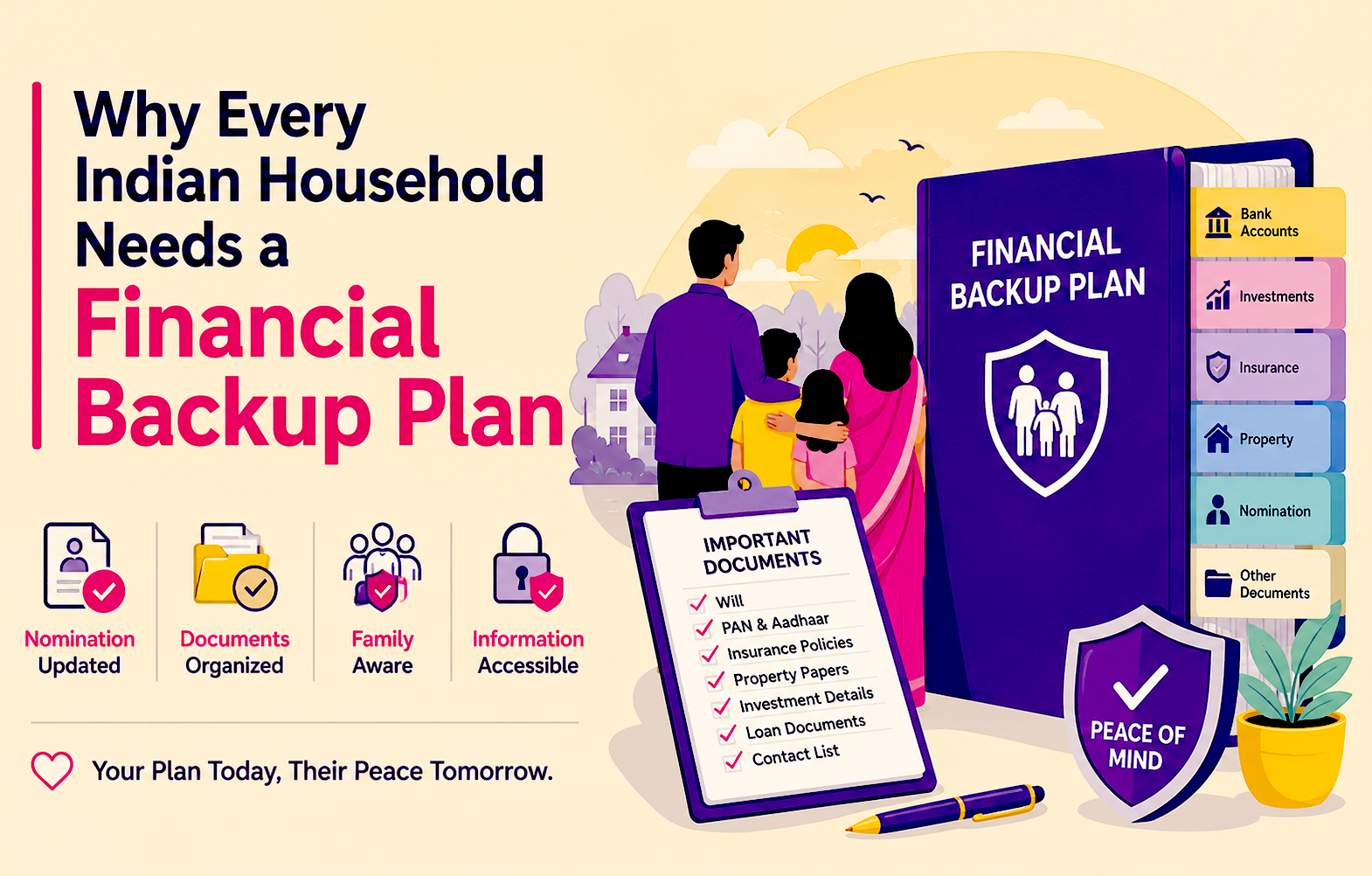
It's a Tuesday evening. Someone in your family just asked, "Where's the FD receipt?"
And there was silence.
Not because the money doesn't exist. Not because the family isn't well-off. But because only one person in the house knows where anything is — which bank, which folder, which app, which password. Everyone else just nods along, trusting that "he/she has it all sorted."
This is the story of almost every Indian household. One person — usually the father, sometimes the husband, occasionally an elder son or daughter who "understands these things" — quietly becomes the sole keeper of the family's entire financial universe: bank accounts, FDs, insurance policies, mutual funds, PPF, EPF, the demat account, gold lockers, property papers, even loan EMIs. Everyone else happily hands over the responsibility and gets on with their lives.
It works beautifully — until the day it doesn't.
The Silent Family Tradition Nobody Talks About
Walk into ten Indian homes and you'll likely find the same pattern in at least seven of them. The reasons are almost cultural at this point:
- Trust over transparency. In Indian families, love is often expressed through not asking questions. "Papa is handling it" is treated as a complete answer, not a red flag.
- One "finance-minded" person emerges early. Maybe they were good with numbers, maybe they just took interest first. Over time, this snowballs — they open every new account, they get every new policy, and slowly, they become the only person who understands the full picture.
- Discomfort around mortality. Talking about "what if something happens to me" feels inauspicious, almost like inviting misfortune. So families avoid the conversation entirely — not out of ignorance, but out of a very human discomfort with confronting death.
- Assumption of digital permanence. We assume passwords are "just there," that apps will "obviously" show the full picture, that someone will "figure it out later." But digital finance, ironically, is more fragile than a physical file — if you don't have the login, the OTP number, or the registered email, an account might as well not exist.
None of this comes from bad intentions. It comes from convenience, trust, and the very Indian instinct of "let one person handle it so the rest of us don't have to worry." And that instinct works — right up until it becomes the family's single point of failure.
(Is that one person you, who has the responsibility? Then this comprehensive guide has been built just for you.)
What Actually Happens When That One Person Is Suddenly Gone
This isn't meant to be dramatic, but it needs to be said plainly: people die, fall seriously ill, lose memory, or simply become mentally unavailable — sooner or later, unexpectedly, without warning.
When that happens to the "finance person" of the house, families don't just lose a person. They lose access.
Here's what commonly unfolds:
- Bank accounts get frozen or become inaccessible without proper nomination or documentation, sometimes for months, while the family navigates a legal maze during the worst period of their lives.
- Demat and mutual fund holdings sit untouched because nobody else knows the folio numbers, the broker, or even that the investment exists. Unclaimed investments in India run into thousands of crores for exactly this reason.
- Insurance policies lapse because nobody knew a premium was due, or worse, nobody even knew the policy existed until years later.
- Passwords die with the person. Email accounts, net banking, demat logins — modern finance is guarded by digital locks, and very few families keep a shared, secure record of these.
- Emotional grief gets compounded by financial chaos — exactly when the family has the least capacity to deal with paperwork, courts, and bank branches, they're forced to deal with all three at once.
The tragedy here isn't poor wealth creation. Indian families are, in fact, excellent savers and long-term investors. The tragedy is that all of that carefully built wealth becomes temporarily — or sometimes permanently — invisible to the very people it was built for.
The Real-Life Running Around Nobody Warns You About
Talk to anyone who has actually been through this, and they'll tell you the paperwork isn't the hard part — the not knowing where to even begin is.
Picture this: a family loses its finance person, and a few weeks later, someone finally decides to "sort things out." What follows is rarely a clean process. It's usually months of confusion, dead ends, and repeated trips that could have been avoided with a single document.
- Visiting bank after bank, branch after branch, simply to find out which ones the person even had accounts in — because there was never a consolidated list, just scattered memories of "I think he had an account with that bank."
- Being turned away for missing paperwork, only to return a week later with the right form, and then being told a different document is now needed — a cycle that can repeat for months.
- Struggling to prove identity and relationship to claim insurance payouts or transfer accounts, especially when nomination details were outdated or never updated in the first place.
- Sitting on hold or waiting in queues at broker and mutual fund offices, trying to explain that you don't have the folio number, the client ID, or even the name of the broker — just a vague memory of "some shares" or "some SIP" that existed.
- Digging through old emails and drawers, hoping to stumble upon a password, a policy document, or a statement, often finding nothing because everything was digital and locked behind a phone or an email account nobody else could access.
- Taking repeated leave from work to run these errands, because government offices, banks, and insurers rarely operate on the family's schedule, especially during an already difficult time.
- Paying unnecessary legal fees for succession certificates or affidavits that could have been simplified or entirely avoided with proper nomination and documentation.
- Losing money outright — a policy that lapsed because nobody knew to pay the premium, an investment that stayed unclaimed for years, interest that was never claimed because the account was simply forgotten.
What makes this especially cruel is the timing. This running around doesn't happen when the family has the energy or emotional bandwidth to deal with it — it happens right after a loss, when people are grieving, exhausted, and least equipped to fight through bureaucracy. Grief and government paperwork rarely mix well, yet Indian families are routinely forced to handle both together.
And this isn't a rare, unlucky scenario. Ask around, and you'll find that almost every extended family has at least one story like this — an aunt who spent a year trying to locate her husband's investments, a cousin who discovered a forgotten LIC policy only when a bank sent a lapse notice, a friend whose family still hasn't traced an old PF account. These stories are so common that they've almost become background noise — treated as "just how things are," instead of a solvable problem.
That is exactly why documentation matters more than most families realize. It's not about distrust or expecting the worst. It's about sparing the people you love from spending their grief chasing paperwork instead of processing a loss.
(If you want to kick-start on this right away, download this ready-to-use guide.)
Wealth Creation Without Wealth Continuity Is an Incomplete Plan
There's a quiet but important shift needed here: building wealth and organizing wealth are two different skills, and most families only invest in the first.
You can have a diversified portfolio, a healthy emergency fund, three insurance policies, and a growing SIP — and still leave your family stranded, simply because none of it is documented in a way others can access and understand.
Wealth creation asks: "How do I grow this money?" Wealth continuity asks: "If I'm not here tomorrow, can my family actually use this money?"
Both questions deserve equal attention. Right now, most Indian households only ever ask the first one.
How to Actually Fix This (Without Making It Awkward)
The good news: this doesn't require a dramatic family meeting titled "In Case I Die." It just requires a shift from tribal knowledge to documented knowledge. Here's a practical way to approach it.
- Create one master financial document — a "family finance map."Not the actual passwords, but a structured list: which bank, which branch, account type, insurance company and policy numbers, demat broker name, mutual fund folios, property documents and where they're kept, loan details, and nominee names. This single document, even in a simple spreadsheet, can save a family months of chaos.
- Update nominees everywhere — properly.Most Indians nominate someone when opening an account and never revisit it. Marriages happen, children are born, relationships change — but nominee details from 2008 often quietly remain untouched. Review every account, insurance policy, PF, and demat holding once a year.
- Pick one trusted second person — not for control, just for awareness.This isn't about handing over decision-making. It's about ensuring at least one other family member — a spouse, an adult child, a sibling — knows that things existand roughly where to look. Awareness, not access, is the first goal.
- Store critical documents in one known, safe place.Physical documents (property papers, FD certificates, insurance policies) and a note on where digital accounts are held should live in one place the family knows — a locker, a folder, a fireproof box — not scattered across drawers only one person understands.
- Use a password manager, and share the master access responsibly.Digital finance is now the norm, and password managers like Bitwarden or built-in options can securely store login details, with an emergency access feature that many people don't know exists.
- Make this a routine, not a one-time task.Revisit the family finance map once a year — perhaps during a birthday, a new financial year, or a festival when the family is together anyway. Treat it as maintenance, not mourning.
- Talk about it in practical terms, not emotional ones.Frame it as "let's organize our finances better" rather than "let's plan for when I'm gone." The outcome is the same, but the conversation becomes far easier to start.
If you want get started right away, to secure your family's financial future, download this ready-to-use Family Financial Wealth Guide and take the first step toward making your wealth easily accessible when it matters most.
A Small Shift, A Massive Difference
None of this is complicated. It doesn't require a financial advisor, a lawyer, or an uncomfortable, tearful conversation. It requires one afternoon, one spreadsheet, and one honest conversation with the people you trust most.
Indian families have never struggled with earning or saving money — that instinct runs deep. What we've struggled with is talking about it, documenting it, and sharing it before it becomes urgent.
Because wealth, no matter how carefully built, is only as strong as the family's ability to find it, understand it, and use it — with or without the one person who built it.
The best time to organize this was years ago. The second-best time is this weekend.
----------
Invest Smarter: Choose the Right Fund for You!
Schedule A CallRelated Blogs
- 13+ Ways to Grow Your Money. You’re Probably Using Just One.
- Planning Retirement Mutual Funds? Here’s What You Missing.
- Retirement Planning with Multiple Income Streams
- From Salaries to Wealth: Investing During 30s & 40s For Your Goals
- Risk & Financial Hygiene in Mutual Fund Investing
- Why Safe Isn’t Always Safe – Equity Vs FD
- Seamless Wealth Creation With MINTIT For Modern Investors
- Why Emotional Investing Costs More Than Bad Markets
- The New Year Wealth Reset: Small Habits, Big Financial Results
- Couples & Money: Why “Joint Goals” Often Fail Without Joint Discipline
- SIP vs Lump Sum, The Ultimate Guide for First-Time Investors
- Automate Wealth Creation with SIPs on Mutual Funds App
- Child Education Planning with Safe SIP Plans: A Guidebook
- Tax efficient regular income with Mutual Funds SWP
- Set a Milestone with MINTIT: A Trusted Mutual Funds Mobile App
- Here’s How the Best App for Investing in Mutual Funds Helps
- Use Market To Pay Your Loan Interest With This SIP Plan
- Understanding The Risk Associated with Speculation: The Right Way
- Rich Investing: AIFs & PMS
- Investing Via Mutual Funds; For Growth
- Investing In ‘Real’ Asset; A Guidebook For Real Estate Investments
- Savings Net; A Financial Backbone
- Buy Insurance Before You Regret
- Emergency Fund: The Right Way To Build It
- Securing Your Wedding Fund This Valentine
- Leverage Tax Relief to Speed Up Building Rs 1 Cr Corpus
- Financial Mistakes Across the Ages of an Individual.
- How setting a financial milestone defines your financial journey?