How to Create Wealth With Market Volatility
Jun 18, 2026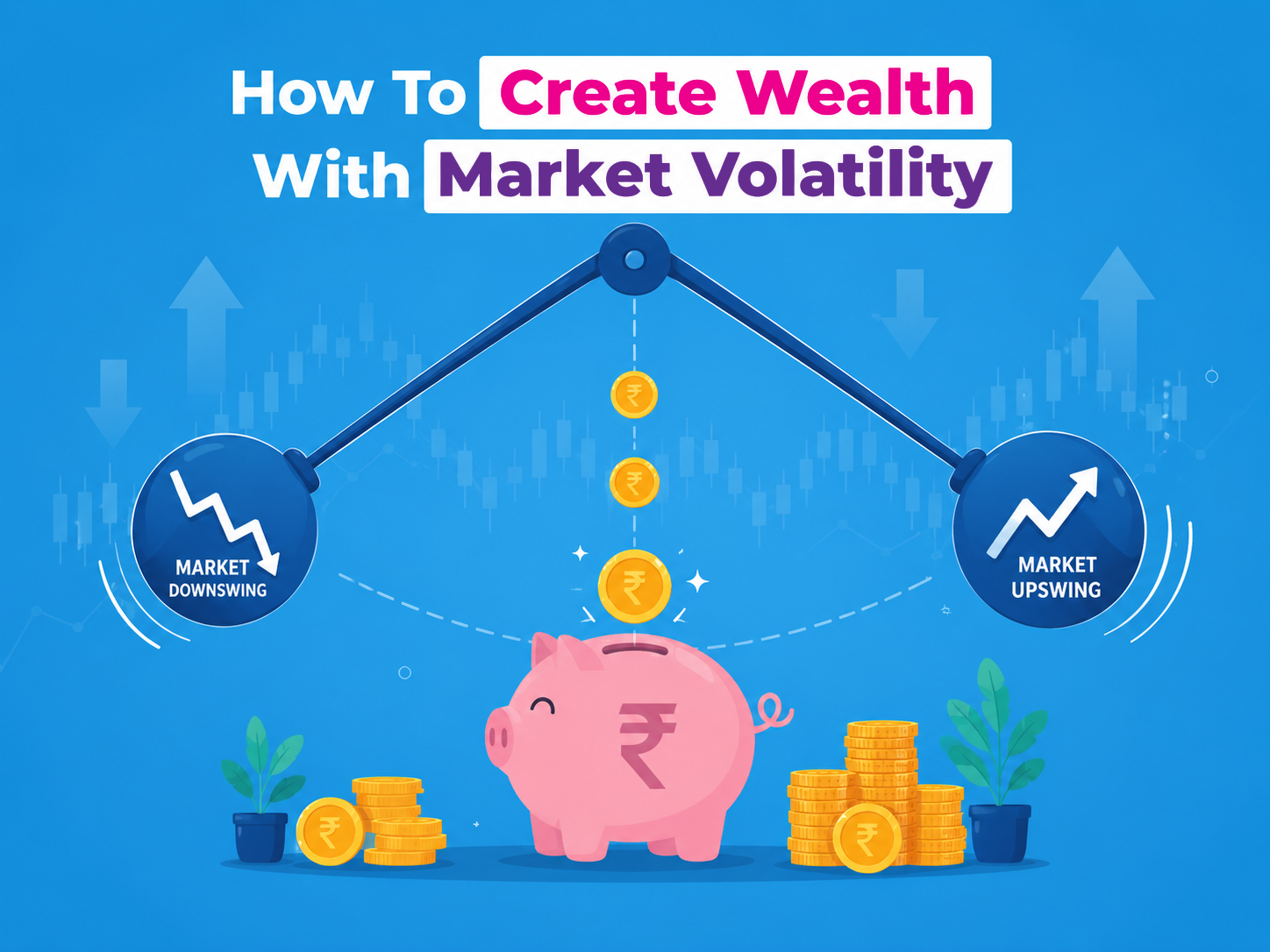
Financial markets around the globe tumble when faced with heightened uncertainty due to internal or global recession, wars, sharp increase in crude oil, bond yield or in safe-haven metals like gold and silver.
Such times frequently evoke anxiety that exceeds the actual fundamentals, as market sentiment is heavily influenced by geopolitical events and commodity price fluctuations.
Such events can turn the equity market extremely volatile which can be measured by India volatility index (VIX). However, the VIX or volatility does not represent any fundamental shift, instead it reflects the fear and greed sentiments among the investors.
Volatility Explained
Volatility means markets moving up and down frequently, often due to news, economic events or geo-political disturbances. Imagine volatility like turbulence in an airplane which is a short-term event, it does not last long.
Volatility does not mean markets are permanently falling. It simply means prices are moving up and down in the short-term. While volatility can make investors uncomfortable, it is quite normal in the equity markets.
Volatility During Times of Wars
Markets have met extreme wars in the past where it felt like the world is going to end. Wars like Kargil, Crimea Annexation, Russia Ukraine or Israel-Hamas have made markets volatile and vulnerable in the past.
However, data across past geopolitical events shows the Sensex delivered an average 16% return in one month post event, 27% in three months and 37% six months after the initial shock. Below is the table to analyse the war times market reaction, and its resilience afterwards.
|
War Date |
Countries |
Peak |
Peak Return |
|
May 1999 |
Kargil War (Ind-Pak) |
- 6% |
29% |
|
March 2003 |
Iraq War (US-led) |
- 5% |
71% |
|
March 2014 |
Crimea Annexation |
- 2% |
38% |
|
Feb 2022 |
Russia-Ukraine War |
- 12% |
4% |
|
Oct 2023 |
Israel-Hamas |
- 3% |
26% |
Panic selling, mutual funds withdrawal, early redemptions are some common mistakes which retail investors do, however the ones with experts’ guidance accumulate more, use the rupee-cost averaging and beat the 12-15% average compounded annual growth (CAGR) in the long-term.
Why Markets Fall During Geo-political Disturbance
Markets do not like uncertainty because in the short-term market is a sentimental ground. Now during war or any geo-political events, uncertainty trades like a virus. Foreign investors sell in emerging markets like India, Taiwan, Korea etc.
Bond yields rise which make debt instruments such as fixed deposits, corporate bonds, government bonds more attractive. Moreover, gold and silver also act as a hedge during these times. Hence, money outflows from stock markets to other asset classes.
Mistakes By Investors In Volatile Times
As an investor, volatility can make you uncomfortable especially when the markets are sharply falling. However, these are the times when wealth creation checks your patience, discipline and trust on long-term investing.
MINTIT suggests a few typical mistakes which investors must avoid. The tech-led mutual fund platform strictly advises to not stop SIPs as these are the opportunities to accumulate more units.
Also, redeeming investments during market corrections can eliminate you from wealth creation. “Stagger fresh deployment using SIP style averaging and treat volatility spikes as entry signals, not exit alarms,” says Ajay Patwari, Co-founder MINTIT.
Patwari also suggests that SIP investors should not switch funds and strategies without expert advice. “SIP investors should follow trusted mutual fund advisors and keep investing in the funds which align with your goals.”
MINTIT, India’s dedicated Mutual Fund Platform caters to your personalized goals and accompanies you to achieve your financial milestones.
Depending on your profile it precisely suggests tailored investing plans to achieve your goals through best suited mutual funds. Sign up to MINTIT now and start your SIP journey with professional guidance.
You can also download the MINTIT guidebook on “What to do when markets are falling” to make sure your investment decisions are on the right path.
Stop Thinking Start SIPing
If you keep waiting for the perfect time to re-enter mutual funds, you can miss out on a lot of gains. Therefore, SIP discipline is the most empirically validated strategy.
SIP inflows in February 2026 rose 15% year on year (YoY) to Rs 29,845 crore; January 2026 inflows rose 17% YoY to Rs 31,000 crore, confirming relentless retail participation growth through every phase of market volatility.
The overall Mutual Fund industry's structural expansion continues. Total mutual fund industry AUM rose to Rs 83.42 lakh crore at the end of February 2026, with net inflows of Rs 94,530 crore in February, supported by strong investor interest in equity funds, debt schemes and passive products simultaneously.
Volatility must not distract you from investing towards your goals because every SIP matters.
To achieve your goals with SIP investing, download the MINTIT app to begin your investment journey with guided, goal-focused support and right mutual funds.
Stop Thinking. Start SIPing.
Invest Smarter: Choose the Right Fund for You!
Schedule A CallRelated Blogs
- What Psychology Really Tells Us About the Way We Invest
- Why Planning a Vacation Feels Like Scamming Your Investments?
- The Psychology Behind Portfolio Rebalancing
- SIP Growth Over Years: A Magical Chart
- Your Wealth, Your Recipe, Your Flavours and MINTIT’s Guidance
- From Mantras to Mutual Funds: The Modern Interpretation of Laxmi’s Teachings
- Insurance & SIPs Through Mutual Funds App: Perfect Duo For A Secure Future
- Women & Wealth: SIPs Empowering the New Generation of Investors
- How Long-Term SIP Investment Protects Your Future from Inflation
- Your Shield Against Inflation: Long Term SIP Investment Through MINTIT’s Mutual Fund Mobile App
- The Hidden Risk of Over-Diversifying Mutual Funds
- Hard Truths of Dividend Income
- Enjoying Regular Income Via SWP
- Farewell Warren Buffett; Lessons From Investor With Networth of Rs 14 Lakh Crore
- Why Taking Time Before Making Investment Decisions Can Be Beneficial?
- Why Risk Profiling is Important & How to Conduct Your Own?
- How to Become a Smart Investor?
- Best Attitude practices for an Investor to avoid investment biases.